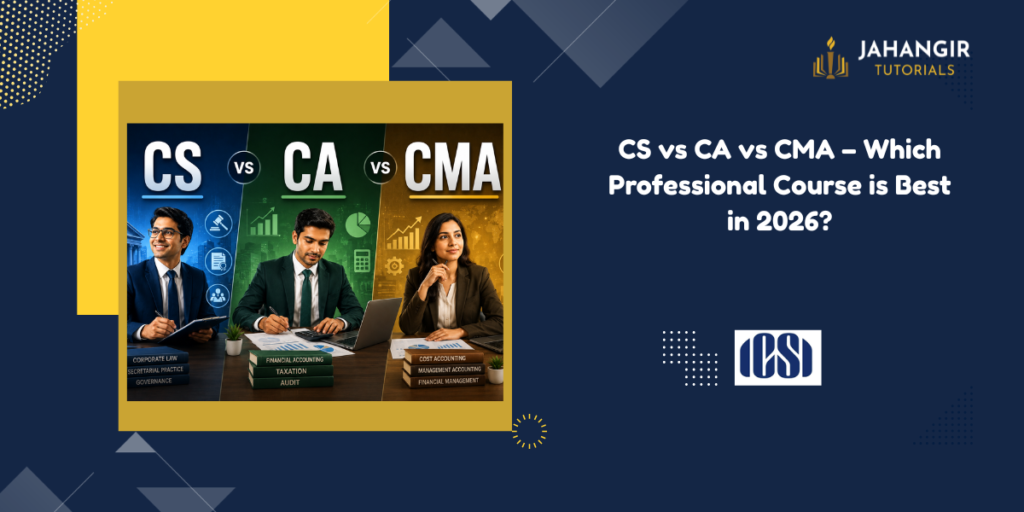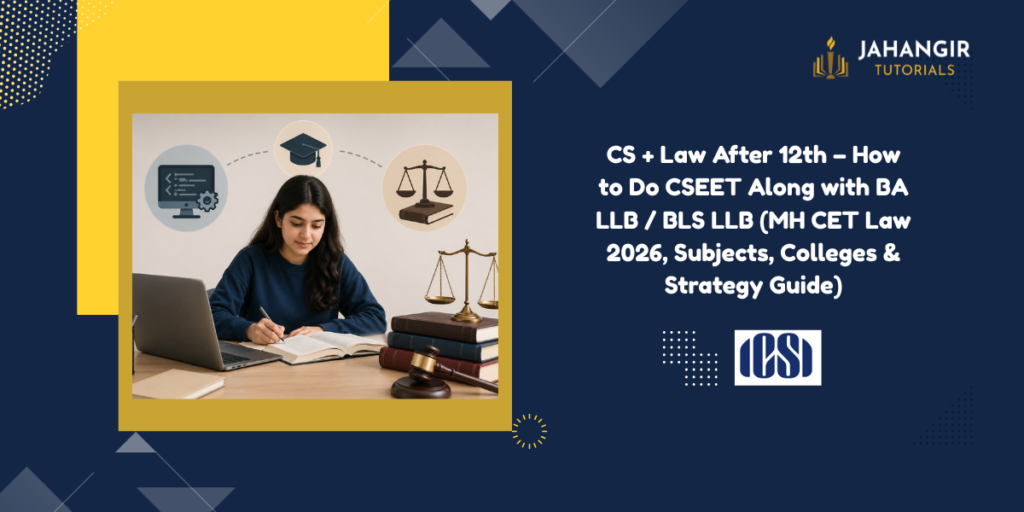

Introduction of CS vs B.Com vs Law
After completing Class 12, commerce students often face a crucial question:
“Which course should I choose – CS, B.Com, or Law?”
Each option offers different career paths, but the right choice depends on your interest, career goals, and long-term vision.
This guide compares all three options and also explains:
- CS course structure (with CSEET details)
- Syllabus, fees, and registration process
- CSEET October 2026 attempt
- Career scope
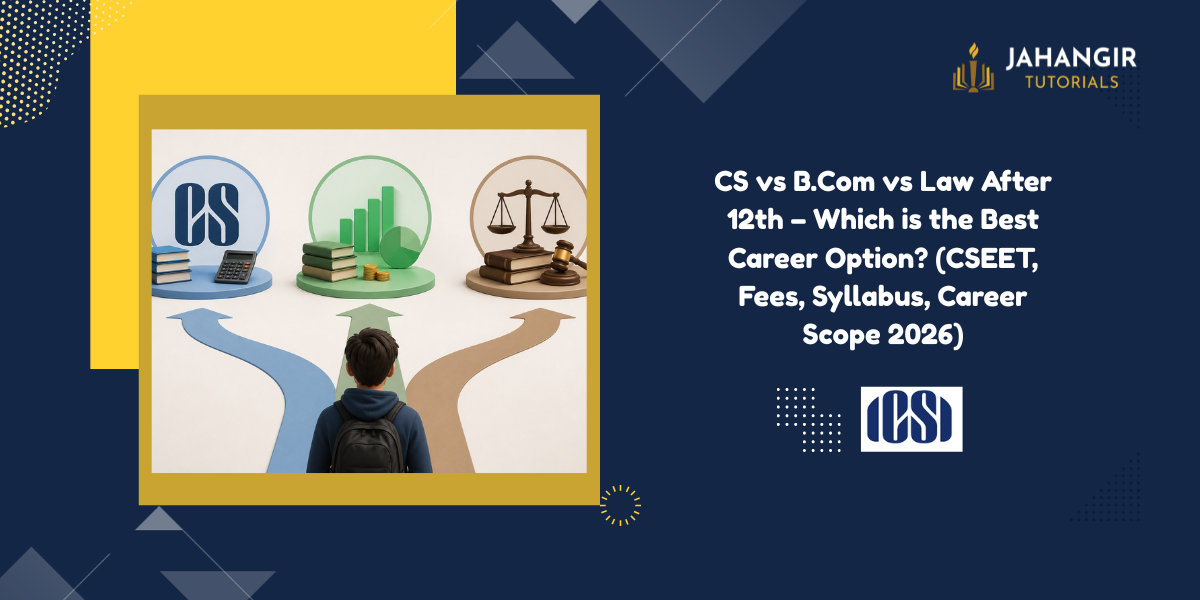
Overview of the Three Career Options
1. Company Secretary (CS)
A professional course focused on:
- Corporate laws
- Compliance and governance
- Legal advisory
Starts with CSEET (entry-level exam).
2. B.Com (Bachelor of Commerce)
A graduation degree focusing on:
- Accounting
- Finance
- Business studies
3. Law (LLB)
A professional degree focusing on:
- Legal system
- Litigation
- Judiciary
CS Course Structure (With CSEET Details)
Stage 1 – CSEET
CSEET Syllabus
| Paper | Subject | Marks | Nature |
| Paper 1 | Business Communication | 100 | Subjective |
| Paper 2 | Fundamentals of Accounting | 100 | Subjective |
| Paper 3 | Economic & Business Environment | 100 | Subjective |
| Paper 4 | Business Laws & Management | 100 | OMR |
Total Marks: 400
CSEET Exam Pattern (2026)
- Centre-based
- 4-day examination
- No negative marking
CSEET Fees
- Registration Fee: ₹7,500
- Exam Fee: ₹1,500
CSEET Registration Process
- Apply through ICSI portal
- Upload documents
- Pay fees
- Submit form
CSEET October 2026 Attempt – Key Dates
- Last Date: 31 May 2026
- Exam: First week of October 2026
Important:
Students after 12th results can directly appear for this attempt.
Detailed Comparison – CS vs B.Com vs Law
| Factor | CS | B.Com | Law (LLB) |
| Type | Professional | Degree | Professional |
| Focus | Corporate Law & Compliance | Commerce basics | Legal system |
| Entry | CSEET | Direct admission | Entrance exams |
| Duration | 3.5–5 years | 3 years | 3–5 years |
| Cost | Moderate | Low | Moderate to high |
| Difficulty | Moderate | Easy to moderate | Moderate |
| Career | Corporate roles | Limited without specialization | Litigation/Corporate law |
Which Course is Best After 12th?
Choose CS if:
- You are interested in corporate laws
- You want a professional qualification
- You aim for corporate roles
Choose B.Com if:
- You want a basic commerce degree
- You plan to pursue further studies
Choose Law if:
- You want to become a lawyer
- You are interested in litigation
CS Executive & Professional Overview
CS Executive Subjects
- Company Law
- Tax Laws
- Accounting
- Securities Law
CS Professional Subjects
- Governance
- Audit
- Corporate restructuring
Career Scope Comparison
After CS
- Company Secretary
- Compliance Officer
- Corporate Legal Advisor
- Independent Practice
After B.Com
- Requires further specialization (CA, MBA, etc.)
After Law
- Lawyer
- Legal advisor
- Judiciary
Why CS is a Smart Choice in 2026
- High demand in corporate sector
- Mandatory compliance roles
- Strong earning potential
- Opportunity for independent practice
CSEET Preparation Strategy
- Start after 12th exams
- Focus on concepts
- Practice regularly
- Revise thoroughly
CSEET Coaching in Mumbai – Jahangir Tutorials
Offline Classes
- Andheri West
- Classroom-based teaching
Online Classes
- Live English lectures
- Available across India
Features
- Structured syllabus
- Exam-oriented notes
- Mock tests
- Revision sessions
Conclusion of CS vs B.Com vs Law
While all three options have their own advantages, the CS course stands out as a professional qualification with strong career growth and corporate opportunities.
Students who are interested in law, compliance, and corporate roles should strongly consider pursuing CS after 12th.
Get in Touch with Jahangir Tutorials for Company Secretary Executive Entrance Test, CS Executive and CS Professional Classes now.
Follow us on YouTube to stay updated.